Why Architecture Still Wins
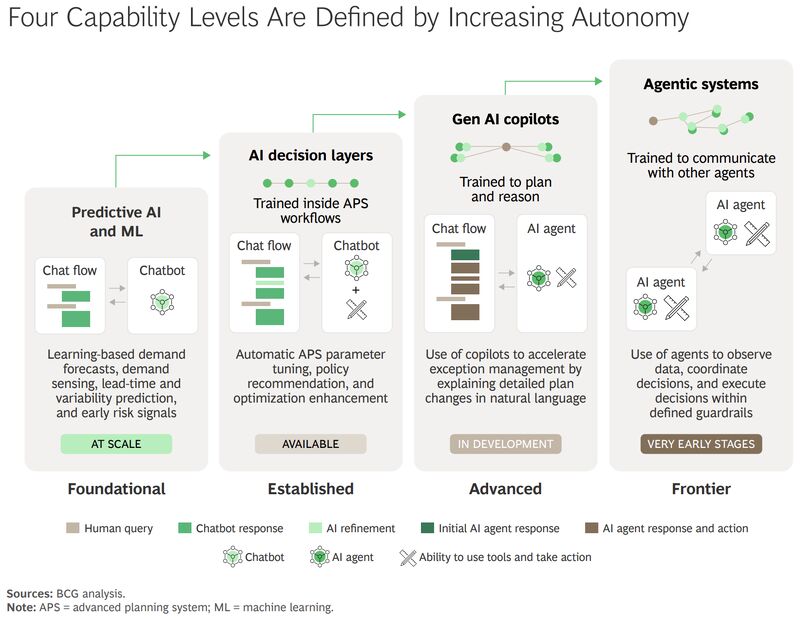
I recently reviewed BCG’s Supply Chain Planning 2026 report, and one exhibit in particular stood out. It maps the progression of AI in planning from predictive models, to decision layers inside APS, to copilots, and eventually to agentic systems with increasing autonomy.
The visual is powerful. But the underlying message is even more important.
AI is presented as an intelligence layer. It is not positioned as a replacement for planning architecture.
That distinction matters.
Improving Prediction vs Improving Performance
There is a fundamental difference between improving prediction and improving system performance.
AI can enhance forecasting. It can detect patterns faster, tune parameters dynamically, and accelerate exception management. These capabilities are real and increasingly accessible.
However, if the underlying replenishment logic is structurally sensitive to forecast error, better algorithms simply optimise instability.
You do not solve volatility by calculating it more precisely.
You solve volatility by designing it out of the system where possible.
This is where architecture becomes decisive.
The Limits of Forecast-Centric Thinking
Most organisations still operate planning systems that are heavily dependent on forecast accuracy at SKU-location level. When volatility increases, the response is typically to invest in better analytics.
But even significant improvements in forecast accuracy often fail to translate into proportional improvements in service, inventory, or responsiveness.
Why?
Because the system architecture amplifies forecast error. Long lead times, tightly coupled nodes, and nervous MRP logic create structural fragility.
In that context, AI improves the signal, but the system remains sensitive to noise.
The Role of DDMRP
Demand Driven MRP addresses a different layer of the problem.
Instead of trying to perfect prediction, it reduces structural dependence on it. Through strategic decoupling and buffered flow, DDMRP absorbs variability rather than transmitting it downstream.
This does not compete with AI.
It complements it.
AI improves sensing and decision speed.
DDMRP stabilises the decision environment.
AI makes the system smarter.
DDMRP makes the system less fragile.
When autonomy increases, fragility becomes even more dangerous. Automation layered onto unstable logic simply accelerates the wrong outcomes.
Autonomy requires stability.
The Relevance of the Demand Driven Operating Model
The conversation does not stop at replenishment logic.
The Demand Driven Operating Model extends this architectural thinking into governance, cadence, and cross-functional alignment. It embeds clear decision rights, structured buffers, and disciplined execution rhythms.
These are precisely the foundations highlighted in the BCG report as prerequisites for scaling AI successfully.
Without operating maturity, AI becomes another underutilised tool.
With architectural discipline, AI becomes a force multiplier.
The Real Strategic Question
The leadership discussion should not centre on how autonomous AI will become.
It should centre on whether the planning architecture is stable enough to support autonomy.
Intelligence layered onto weak foundations amplifies noise.
Intelligence layered onto disciplined architecture amplifies performance.
Technology will continue to evolve rapidly.
Competitive advantage will belong to organisations that treat planning architecture and operating discipline as strategic design decisions, not system configurations.
AI is accelerating.
Architecture still wins.