
Demand Driven planning in South Africa
Turn inventory into cash with flow-based planning.
We help manufacturers and distributors move from forecast-driven MRP to DDMRP. Certified Demand Driven practitioners, backed by over 70 years of combined Microsoft Dynamics and supply chain experience.
Why flow-based planning matters
Volatility, long lead times and rising customer expectations mean a forecast-driven plan alone can’t keep up. Flow-based planning restores stability, so your team responds to real demand instead of chasing the forecast.
Reduces noise
Shields flow from demand spikes, forecast error and variability.
Shortens decision cycles
Faster response to market signals, with fewer firefights.
Aligns priorities
Every function works from the same view of what matters most.
What Demand Driven actually means
A shift from relying on forecasts to a model that senses real demand and adapts to it.
It doesn’t mean
- Forecasting everything more accurately
- Making every product to order
- Using simple pull everywhere
- Holding excess inventory just in case
It does mean
- Protecting flow at the points that matter
- Stable, visible priorities for planners
- Replenishment driven by actual consumption
- Faster, calmer response to change
The six components of DDMRP
Position, protect, pull and adapt. DDMRP places strategic decoupling points in your supply chain and drives replenishment from actual demand, not forecast volatility.
01
Strategic decoupling
Place stock where it best absorbs variability and protects flow.
02
Buffer profiles and levels
Size buffers using lead time, variability, average daily usage and product characteristics.
03
Dynamic buffer adjustments
Adapt buffers to seasonality, trends and real-time operational signals.
04
Demand driven planning
Set supply order priorities with the net flow equation.
05
Visible and collaborative execution
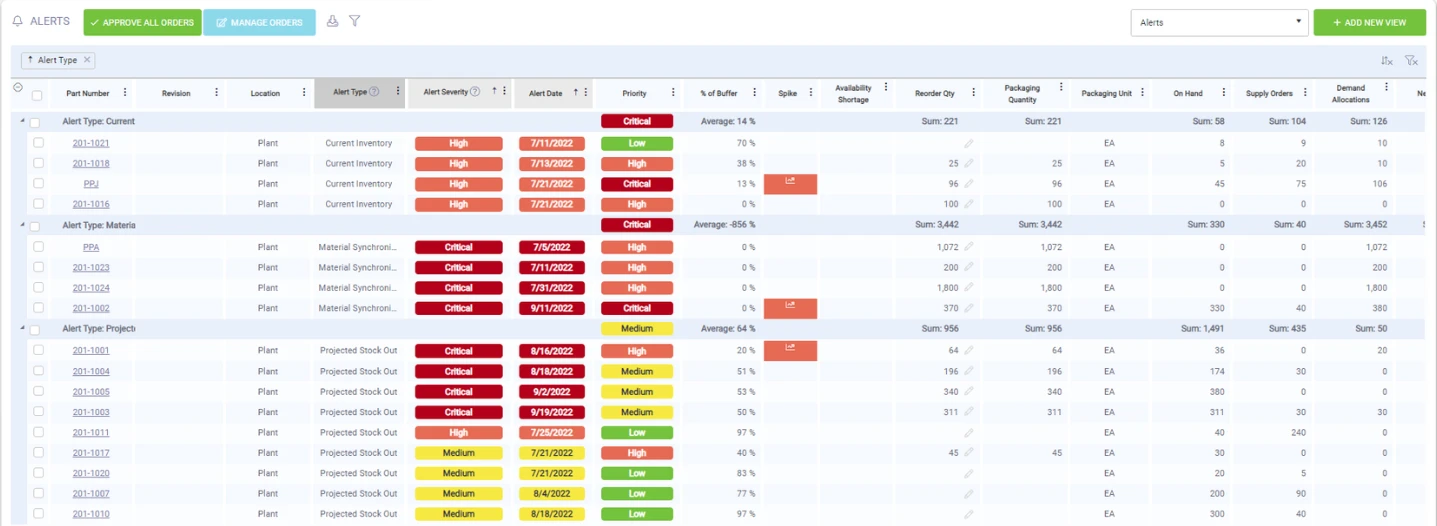
Use execution alerts to protect flow and keep decisions aligned.
06
Tactical adaptation
Review buffer performance and planned events through Demand Driven S&OP, and adjust the settings behind the first three components.
Becoming a Demand Driven Adaptive Enterprise
We work through all three layers of the DDAE model, starting with stable operations.
Operational
DDMRP and DDOM
Stable flow, clear priorities and execution aligned to demand.
Tactical
Demand Driven S&OP
Synchronised planning horizons that adapt to change.
Strategic
Adaptive S&OP
Links operational reality to long-term direction and capacity.
What clients achieve
Higher service levels
Better fulfilment and happier customers.
Shorter lead times
Shorter planning cycles and faster response.
Leaner inventory
Lower stock while protecting availability.
Planning stability
Less noise, fewer reschedules, clearer priorities.
Operational agility
Better adaptability in volatile conditions.
Working capital released
Cash freed up from excess and obsolete stock.
Who we work with
Manufacturing
Distribution and warehousing
Food and beverage
Chemicals
Automotive and assemblies
Aerospace and industrial
Retail and supply networks
Healthcare and pharmaceuticals
What could flow release for you?
Excess stock in the wrong places ties up cash that could be working elsewhere. Put in your own numbers to see the order of magnitude.
Cash released from stock
R 10 000 000
Carrying cost saved every year
R 2 500 000
Illustrative only. Your real number depends on where buffers sit and how much of today’s stock is excess. The free two-day assessment puts a figure on it.
Get your real numberWhat we offer
From training your planners to running the full implementation.
Certified Demand Driven training
Official DDI programmes, Demand Driven Planner (DDP) and Demand Driven Operations (DDO), taught in-house by a DDI endorsed instructor.
DDMRP simulations
Model your supply chain on real demand history to show savings and risks before you commit.
Full Demand Driven enablement
End-to-end DDMRP and DDOM implementation.
Microsoft Dynamics integration
Connect Dynamics 365 with your planning and execution workflows.
Supply chain consulting
Practical work on variability, constraints and process design.
Works with any ERP
Microsoft Dynamics, SAP, SYSPRO, Oracle and others, so data keeps flowing and planning stays aligned.
“Their expertise in Demand Driven Material Requirements Planning (DDMRP) has transformed the way we approach demand planning in a highly complex operational environment.”
Ruandre Roux, Senior Business Analyst, Agri Technovation
Questions we hear
Straight answers to what planners, buyers and finance teams ask us before they start.
Is DDMRP just safety stock with a new name?
No. Safety stock sits on top of a forecast-driven plan. DDMRP buffers sit only at chosen decoupling points, are sized from average daily usage, lead time and variability, and move as those change. Replenishment is triggered by the net flow equation: on hand plus on order, minus qualified demand.
Do we still need a forecast?
Yes, for a different job. Forecasts and planned events still shape buffer adjustments, capacity and S&OP. Daily supply orders come from actual consumption, so forecast error stops flowing straight into purchase and production orders.
Will DDMRP work with our ERP?
Yes. Your ERP stays the system of record. DDMRP runs on top of it in compliant planning software such as Intuiflow, and Microsoft Dynamics 365 Supply Chain Management is itself on the Demand Driven Institute’s list of compliant systems. We work with Dynamics, SAP, SYSPRO, Oracle and others.
How long does an implementation take?
It depends on the number of items and locations and on the state of your data. We start with the two-day assessment and then give you a phased plan with dates. We usually recommend proving the model on one product family or site before rolling it out.
What training do our planners need?
Planners and buyers normally start with the Demand Driven Planner (DDP) programme, which prepares them for the DDI’s Demand Driven Planner Professional (DDPP) endorsement. Operations teams take Demand Driven Operations (DDO), which leads to the DDOP. Both are official DDI programmes, taught by our own DDI endorsed instructor.
What happens in the free two-day assessment?
We spend two days in your operation and show you where flow is breaking down, what it is costing you and what fixing it would take. It costs nothing.
Start with a free two-day assessment.
A no-obligation, on-site review that shows where flow breaks down, what it’s costing you, and where modern planning can deliver measurable gains.
- On-site workflow observation
- Stakeholder interviews
- ERP and planning system review
- Planning readiness analysis
- Diagnostic insights and roadmap
- Leadership alignment session
Roald Wagener
Demand Driven Supply Chain Consultant